Hindutva and its cult of the bomb Praveen Swami Events since the unravelling of the Malegaon terror cell illustrate the double-standards, deceit and denial that characterise India’s public discourse on terrorism. The Indian Mujahideen (IM) warned the citizens of Mumbai through e-mail in September that for all the deadly attacks they faced in future, the city’s Anti-Terrorism squad alone would be responsible. In the e-mail, the Islamist terror group charged the ATS with perpetrating atrocities on Muslims in Mumbai. Politicians of the Islamic right-wing — and not a few well-meaning liberals — joined the chorus, charging the police with running a communal witch-hunt.
The ATS is again facing a barrage of invectives — this time led by Hindutva groups which were cheering it on the successful counter-terrorist campaign against the IM. Last month, ATS investigators held Gujarat-based Hindutva activist Pragnya Singh Thakur and four other key members of a Hindutva terror cell for executing the September 29 bombing outside the Students Islamic Movement of India’s old office in Malegaon. Six Muslims died in the bombings, which the police believe were a reprisal for the IM attacks.
Events since then have offered not a little into the double standards, deceit and denial that characterise India’s public discourse on terrorism. Bharatiya Janata Party president Rajnath Singh proclaimed that there was no evidence against Pragnya, echoing almost verbatim the assertions by Islamist leaders after the arrests of IM suspects. The party spokesperson, Ravi Shankar Prasad, railed against what he described as “Hindu-bashing by pseudo-secularists” — a formulation near-identical to that of Muslim neoconservatives who claim that the police’s counter-terrorism campaign is a plot against Islam. Shiv Sena chief Bal Thackeray went one step further claiming that Hindus were being framed for acts of terror by Islamist conspirators — again, a carbon copy of assertions made earlier in the context of Islamist terror cells. And borrowing the tactics used by some jihadists’ families, Pragnya’s father appeared before the media to proclaim her innocence in an emotional speech.
ATS chief Hemant Karkare and his subordinates ought to be taking pride in a job well done. And Indians, whatever their political beliefs, ought to be very worried.
It is unclear just why anyone should seem surprised at the news that Hindutva groups can spawn terrorism: Mahatma Gandhi’s murderers and their motives are too well known to need recounting here.
Pragnya Thakur’s cell is the first Hindutva terror group known to have possessed and deployed significant bomb-making skills but elements of the movement she represented have long been known to be preparing for a war — at least since 2003. Underlying the turn to terror was a simple political objective: to persuade their audience that the Bajrang Dal and its sister organisations could, unlike the supposedly effete secular state, protect the frontiers of the Hindu faith from what was claimed to be an Islamic assault.
Terror capabilities From 2006, it became clear, Hindutva groups were seeking to acquire serious terror capabilities. That summer, Naresh Kondwar and Himanshu Phanse of the Bajrang Dal were killed in a bomb-making accident in the Maharashtra town of Nanded. Investigators found that Kondwar and Phanse were responsible for bombing a Parbhani mosque in April 2006, almost three months before the Mumbai serial bombings. Bajrang Dal operatives linked to the Nanded cell, the police discovered, were also responsible for the bombing of mosques at Purna and Jalna in April 2003, in which 18 people were injured.
Few people took these warning signs seriously. But from the outset, the Maharashtra police — who knew better than most that what eventually flowered into the Lashkar-e-Taiba in India began with a handful of untrained men staging parades in a Mumbai slum —made clear their concern about Hindutva terrorism. In a 2006 interview to the magazine Communalism Combat, the former ATS chief K.P. Raghuvanshi noted that the Nanded incident could have “frightening repercussions.” He acidly observed that the “bombs were not being manufactured for a puja.”
Just this June, Hindu Janajagruti Samiti operatives were held for the bombing of the Gadkari Rangayatan theatre in Thane, to protest the staging of a satire on the Mahabharata, Amhi Pachpute. One of those arrested by the ATS, Mangesh Nikam, was facing trial on charges of bombing the home of a Ratnagiri family that had converted to Christianity and was out on bail.
In October, Bajrang Dal-linked Rajiv Mishra and Bhupinder Singh were killed in a bomb-making accident in Kanpur. Uttar Pradesh police sources said there was little to show that the group had links with the terror cells in Maharashtra — a proposition buttressed by forensic reports which said the explosive device they were constructing was in essence a large firecracker.
Unless checked, though, these groups will eventually acquire more sophisticated capabilities. In September 2006, the police seized a 195-kg cocktail of military grade explosives from an Ahmednagar scrap dealer. Shankar Shelke, investigators later found, retrieved the material — more than enough to execute all terror strikes across India since 1993 — from a decommissioned Indian Army ordinance which had sold it as scrap. From Shelke’s telephone records, the investigators established the existence of a huge underground market for high-grade explosives — in the main industrial users who found legally available ammonium nitrate-based slurry explosives a nuisance to store and use.
Pragnya and her Hindutva terror cell have deep — and for some, discomfiting — roots in history. Abhinav Bharat — the organisation from which the terror cell emerged — was founded in mid-2006. Named after a group set up by the Hindutva ideologue Vinayak Damodar Savarkar in May 1904 to wage war against imperial Britain, Abhinav Bharat’s leading figures believed that terror was needed to counter Islamist terror — a belief they put into practice in Malegaon.
Hindutva terrorism was born at the dawn of the 20th century. Influenced by the dramatic impact of terrorism in imperial Russia, the Hindu nationalist leader, Bal Gangadhar Tilak, became increasingly drawn to violence as a tool to achieve Indian independence. A year after the searing 1905 revolution, which compelled Czar Alexander II to grant basic civil rights, Tilak wrote: “The days of prayer have gone.” “Look to the examples of Ireland, Japan and Russia,” he exhorted his followers, “and follow their methods.”
Tilak’s message proved attractive to many young, upper caste Hindu neoconservatives — often the products of western-style education who had found in their re-imagining of Indian tradition a language with which to oppose British imperialism.
Figures like Savarkar, who went on to lead the Hindu Mahasabha and the Rashtriya Swayamsevak Sangh, cast the struggle against Britain as a fight to defend the Hindu faith. In one manifesto, the original Abhinav Bharat’s followers promised to “shed upon the earth the life-blood of the enemies who destroy religion.” Later, the radical right journal Yugantar argued that the murder of foreigners in India was “not a sin but a yagna [ritual sacrifice]” — language that would be entirely familiar to Osama bin-Laden’s jihadist armies today.
Edinburgh-educated Pandurang Bapat was among those who responded to Tilak’s call. In 1908, Bapat is believed to have been given a manual for bomb-making by a Russian chemical engineer. Bapat insisted that his bombs never killed anyone. He was, however, suspected of involvement in the Alipore bomb case — an attack on a British magistrate by Khudiram Bose and Prafulla Chaki which missed its target, and killed two women. “Indian terrorism,” scholar Walter Lacquer has recorded, “was relatively infrequent and on the whole quite ineffective: more often than not, the Indian terrorists managed to kill some innocent bystander rather than their intended victims.”
After the 1909 assassination of William Wylie, Edwin Montague’s political secretary, Hindu right-wing terrorism went into a prolonged period of decline. Bapat shifted focus from seeking the overthrow of the British Raj to education. So did Savarkar’s close associate, Hindutva ideologue B.S. Moonje. In 1937, Moonje founded the Bhonsala Military School in Nashik — an institution to which, ironically enough, two men arrested by the ATS on charges of facilitating the Malegaon bombings were linked.
‘Hindu Fuhrer’ Historian Eugene D’Souza’s work on pre-Second World War German propaganda shows that the Hindu right-wing continued to worship violence despite its tactical turn from terror. In the build-up to the war, Nazi Germany’s covert services reached out to potential allies. “Many vernacular papers in Bombay and Maharashtra belonging to the Hindu Mahasabha,” D’Souza has recorded, “openly preached National Socialism for India and a Hindu Fuhrer in the mould of Hitler.” Interestingly, the Nazi message also appealed to proto-Islamists. Iranian expatriate Saif Azad’s Salar-e-Hind worked to promote fascism in India, casting Jews as criminals. “Strangely enough,” D’Souza has noted, “the otherwise irreconcilable reactionaries and fanatics among both Hindus and Muslims were attracted to the totalitarian doctrine, though their approach was from two opposite directions.” Once again, Islamist and Hindutva terrorists are locked in a fateful embrace.
In a 2003 article, Pakistani scholar-diplomat Husain Haqqani warned that “the rise of Hindu extremism serves as a catalyst for recruitment by extremist Islamists in South Asia.” Haqqani’s bleak statement is borne out by facts. Hafiz Mohammad Saeed, who heads the Lashkar-e-Taiba, was a child of the Partition of India: his hatred for Hindus and India, journalist Zahid Husain has recorded, stemmed from his witnessing the massacre of much of his family on the route from Shimla to Lahore. Not a few of those involved in the Islamist jihad that has claimed thousands of lives in India since 1990 were seduced by violence because of their experience of communal pogroms.
BJP leaders — who often claim to have a special concern for India’s strategic future — must unequivocally denounce the murderers in their ranks. Failing this, they will help to bring the apocalyptic Hindu-Muslim war that groups like the Lashkar hope to precipitate one step closer to realisation.
Dal Khalsa UK


Monday, 10 November 2008
Hindutva Terror

Sunday, 26 October 2008
Saturday, 25 October 2008
Dal Khalsa organizes Shabad-Guru Satkar March
Amritsar Sahib - Rededicating that none but the Granth is the perpetual Guru of the Sikh people, the Dal Khalsa on the occasion of tercentenary of coronation of Guru Granth Sahib made an earnest appeal to all sections of the Sikh society to sink their unwarranted differences, rise above partisan, shun egoism and be faithful to the concept of Sarbat da bhala (the welfare of all). The organization undertook 'Shabad-Guru' satkar march commencing from historic gurdwara Guru Tag Bahadur, Baba Bakala to Damdama Sahib, Hargobindpur. In his address the party president Harchranjit Singh Dhami said this procession was being undertaken in honor of our eternal Guru to commemorate its 300th anniversary that falls tomorrow. He said that Sikhs have been passing through a critical phase of history in the recent times. The challenges before the community are multi-dimensional and to face them the need of the hour was unity within the community. "To build a cordial environment for mutual understanding and trust the major role and responsibility rests on established parties and institutions be it political or religious". He made a proverbial call to empower (politically and socially) younger generation to save them from falling into the trap of social evils like apostasy and drug menace. Addressing the spirited gathering, he said 300 years ago in 1708, before Guru Gobind Singh took for heavenly abode, he expounded a unique proposition, unparalleled in the spiritual history of world religions. He said the Tenth Master proclaimed that henceforth, the Guru Granth Sahib, a compilation of the teachings of the Sikhs Gururs, will be the permanent guide and tutor for every seeker of truth. Every Sikh's life shall revolve around the basic postulates mentioned in the Guru Granth Sahib, he said. Former president Satnam Singh pointed out that since those times, the tug of war between followers of Shabad Guru and that pretending to be spiritual guides continues. While the Sikhs are presently engaged in a bitter struggle against the blasphemous acts of the Sauda dera and DJJS, they are emphatically opposed to all schismatic activities, said party general secretary Dr Manjinder Singh. To ensure unflinching respect for Guru Granth Sahib, the party secretary Kanwarpal Singh reiterated that it was a religious and pious duty of every Sikh to defeat the designs of all such sects and cults, which were propagating the concept of "living gurus" contrary to the fundamentals of the Sikh faith. The organization, in a form of resolution made an appeal to the (Sikh) followers of Namdhari and Radhaswami sects to discard the practice of worshiping a living "Guru" and rejoin the Sikh fold. The resolution reads that the tercentenary celebrations was a fit occasion for reiterating faith in Guru Granth Sahib, as the practice of believing in living gurus ended with the Tenth Guru, who bestowed the guruship to Guru Granth Sahib. To drive their point home, the speakers after speaker quoted hymns from Ardas (Daily prayer) " Agya Payi Akal Ki, Tabe Chalayo Panth, Sabh Sikhan Ko Hukam Hai, Guru Manyo Granth. (By order of the God Almighty, the Khalsa Panth was formed. It is a diktat to all Sikhs that henceforth the Guru is only the Granth Sahib.)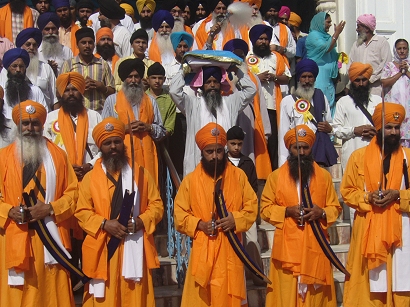
Thursday, 26 June 2008
Dera Sirsa and Hindutava

DSS printed an advertisement featuring Gurmeet ram. This advertisement, coupled with other activities of DSS, demonstrate a deliberate and extremely offensive attempt to copy Sikhi. Specifically, it attempts to copy the creation of "Khalsa," the orthodox manner of Sikhi instituted by the tenth and final Sikh Guru, Gobind Singh. It does this in several ways.
Gurmeet Ram appears dressed in the style of Guru Gobind and seated in "Bir Asaan," the style of seating used by Guru Gobind during the creation of Khalsa. This seating style is still used during Amrit Sanskar, the ceremony in which a Sikh is initiated into Khalsa.Gurmeet ram is portrayed distributing Jaam-e-Insaan, an attempted copy of the Amrit (or nectar) used in Amrit Sanskar. Amrit Sanskar is a vital ceremony in Sikhi. This is when a Sikh is publicly baptized into pure Sikhi and takes the surname "Singh" (or "lion") to denote equality with others in the community. This distribution of Jaam-e-Insaan is also a copy of Khande di Pahul, where nectar is prepared. According to Sikhi, since Guru Gobind only "Panj Pyaras" have the authority to prepare Amrit, which they must do in the presence of Guru Granth Sahib (the Sikh holy book)while following a prescribed method.
Third, Gurmeet Ramincludes a list of "Rules for Humanity" in his advertisement. This is an undeniable attempt to copy the "Rahatnamas" (or "Codes of Conduct") of Sikhi which were instituted by Guru Gobind. While Gurmeet Singh's list of rules are all very similar to those in Sikhi, what is most offensive is his attempt to copy Guru Gobind by issuing such a list.
Fourth, Gurmeet ram ordered his followers to adopt the name "Insaan" (or "human"), in a copy of Guru Gobind's admonition to adopt the name "Singh" (or "Kaur" for women) after Amrit Sanskar. Thus Gurmeet ram has attempted to copy the unique creation of Khalsa by creating Insaan.
DSS has also attempted to copy and offend Sikhs and even other religious groups in several other ways . Just as Guru Gobind taught the importance of "Panj" (or "five"), so Gurmeet Singh has copied this concept by using "Sat" (or "Seven"). Dr. Adyita Insaan, the spokesman of DSS, has equated Gurmeet Singh to Sikh Gurus Gobind Singh and Har Krishan, as well as to Ramachandra, a Hindu god. Additionally, DSS deceptively uses the symbols of the four main religions in India to attract followers: the Sikh Ek Onkar, the Muslim Star and Crescent, the Hindu Om, and the Christian Cross.
In summary, DSS has created an amalgam religion which primarily attempts to copy Sikhi and is offensive to Sikhs and those of many other religions. Under Indian law, this deliberate offense is illegal. Indian Penal Code 295a reads: "Whoever, with deliberate and malicious intention of outraging the religious feelings of any class of [citizens of India], [by words, either spoken or written, or by signs or by visible representations or otherwise], insults or attempts to insult the religion or the religious beliefs of that class, shall be punished with imprisonment of either description for a term which may extend to [three years], or with fine, or with both.]"
In a December, 2002 letter to then Prime Minister of India Atal Bihari Vajpayee, a female member of DSS accused Gurmeet ram of sexually exploiting his "Sadhvis," or female followers. The anonymous author of the letter, whose family urged her to become a "Sadhvi," says:
"Two years after I became a 'Sadhvi', a special woman-disciple of Maharaj Gurmeet ram came to me one night at 10 o'clock and said that the Maharaj had summoned me to his room. I felt elated that Maharaj himself sent for me. I was going to him for the first time. After climbing the stairs, when I went into his room, I saw that he was holding a remote in his hand and was watching a blue [pornographic] film on the TV. Beside his pillow on the bed, lay a revolver.... He offered me water and said that he had called me because he considered me very close to him. This was my first experience. Maharaj took me in his embrace and said that he loved me from the core of his heart. He also said that he wanted to make love with me. He told me that at the time of becoming his disciple, I had dedicated my wealth, body and soul to him and he had accepted my offering. When I objected he said, 'There is no doubt that I am God.'"
Gurmeet ram then blackmailed the "Sadhvi" into having sex with him by threatening to kill her and her family. She claims that many other Sadhvis are regularly raped by Gurmeet Singh, saying that her time comes "every 25-30 days." She says other Sadhvis who have tried to reveal their sexual exploitation have been threatened, beaten, and even maimed. This letter inspired an investigation of the DSS by India's central Bureau of Investigation (CBI).
On October 24, 2003 two men riding a motorcycle and claiming to be from DSS shot journalist Ram Chandra Chatrapati four times at point-blank range. Chatrapati was the editor of "Poora Sach" and had been investigating the recent charges of sexual exploitation by Gurmeet Singh. He died of his injuries a month later. Two men arrested on suspicion of Chatrapati's murder said they were DSS followers and had been sent on orders from Kishan Li, a senior DSS official, to kill Chatrapati because of his investigations.
Sirsa District Deputy Commissioner D. Suresh says his office has also received multiple complaints about the Sirsa-based DSS allegedly being involved in the theft of land, drug distribution, and tax evasion.
After the mid-May 2007 publication of the offensive DSS advertisement, many Sikhs in Punjab protested Gurmeet ram's attempted copy of Guru Gobind. DSS followers retaliated, assaulting many Sikhs and injuring many of the police trying to calm the situation. Over 100 people were injured by DSS followers, many of them police. They also attacked fire personnel, set a police jeep on fire, and attacked a deputy commissioner's residence. Worst of all,
1. Kamaljit Singh, a Sikh, was killed on May 17th by a bullet fired from inside a Sunam, Punjab DSS compound.
2. On 20th june Friday, Guemeet Ram, who is accused of multiple murders and rapes, was visiting a shopping mall in this north-eastern suburb of Bombay when several Sikh youths protested his presence. In response,gurmeet ram and his bodyguards fired many rounds of ammunition from their assault rifles into the crowd of Sikhs, resulting in the death of Bhai Balkar Singh and injuring dozens of others.
Monday, 23 June 2008
sikhs face brutality
On Friday, personal bodyguards of the criminal Sirsa Sauda cultist Gurmeet Ram Rahim opened fire on a group of Sikhs whom were protesting the Bombay visit of the Sirsa cult leader.
Ram Rahim, who is accused of multiple murders and rapes, was visiting a shopping mall in this north-eastern suburb of Bombay when several Sikh youths protested his presence. In response, his bodyguards fired more than 20 rounds of ammunition from their assault rifles into the crowd of Sikhs, resulting in the death of Bhai Balkar Singh of the Bir Khalsa organization and injuring dozens of others.
The Bombay attack brought back the memory of the 1978 Nirankari Sikh massacre at Amritsar Sahib and Kanpur in which dozens of Sikhs were killed by heretic pseudo-Nirankaris.
Criminals Leave Scene after Merciless Killing
According to eyewitnesses the Baba was immediately escorted out of the mall and fled the crime scene within one of the 50 vehicles in his entourage. The news of the attack quickly spread throughout Bombay’s Sikh community, who began blocking traffic in various parts of the city. Sikh activists quickly began to track his caravan and converged to stop the cultists from fleeing.
Realizing the route to the Bombay airport was too dangerous, Ram Rahim‘s 50 vehicle entourage then drove north onto the Pune-Bombay Expressway.
Wednesday, 18 June 2008
Sikhs raise their voice in U.N again (Geneva 10 june)
îÅéÔÅÂÆî, AF ÜÈé (ìÿå ÇÃ³Ø ðÅîÈòÅñÆÁÅ)-Üé¶òÅ ÃÇæå ÿï¹Õå ðÅôàð ç¶ çøåð ÃîÈÔ ÇòÖ¶ ÇÔÀÈîé ðÅÂÆàà սºÃñ ç¶ Hò¶º ÃËôé ÓÚ ò¾Ö-ò¾Ö ç¶ô» Áå¶ Õ½î» ç¶ êÌåÆÇéè» é¶ ÇÔ¾ÃÅ ÇñÁÅÍ ÇÂé·» ÃËôé» ÓÚ Çòô¶ô å½ð Óå¶ ÇÃ¾Ö òøç é¶ ôîÈñÆÁå ÕðÕ¶ ÇÃ¾Ö Õ½î ç¶ îÃñ¶ ê¶ô ÕÆå¶Í ÃðÕÅðÆ Áå¶ öËð-ÃðÕÅðÆ îé¹¾ÖÆ ÁÇèÕÅð ÕÇîôé» ÃÅÔîä¶ çñ õÅñÃÅ ÇÔÀÈîé ðÅÂÆàà Çò¿× ç¶ Ú¶ÁðîËé Ã: ÇêÌåêÅñ ÇÃ¿Ø õÅñÃÅ é¶ ì¯ñÇçÁ» ÇÕÔÅ ÇÕ ÜÈé ÓHD ÓÚ ÃÌÆ ÔÇðî¿çð ÃÅÇÔì À¹µå¶ íÅðåÆ ø½Ü ç¶ Ôîñ¶ ç½ðÅé Áå¶ Ç¿çðÅ ×»èÆ ç¶ Õåñ 寺 ìÅÁç íÅðå ç¶ ò¾Ö-ò¾Ö ôÇÔð» ÓÚ Çþֻ ù îÅÇðÁÅ Ç×ÁÅÍ ÇÂà ïÚÆ-ÃîÞÆ ÃÕÆî ÁèÆé ÇÃ¾Ö Õåñ¶ÁÅî ÃÆÍ ÇÂà ç½ðÅé Ç¿àðéËôéñ Ç¿àðë¶æ ç¶ ÃËÕàðÆ Üéðñ ÇîÃàð ÚÅðñà ×ð¯ò¶Ã çÆ êÌèÅé×Æ Ô¶á ԯ¶ ÃËîÆéÅð ÓÚ E@ î˺ìðÆ ÇÃ¾Ö òøç é¶ ÇÔ¾ÃÅ ÇñÁÅÍ ÃËîÆéÅð ÓÚ ì¯ñä òÅñ¶ ÇÃ¾Ö ì¹ñÅÇðÁ» ÓÚ Ã: ÇêÌåêÅñ ÇÃ¿Ø õÅñÃÅ (ÃÇòÃ) Ã: îéî¯Ôé ÇÃ¿Ø õÅñÃÅ (Ç¿×ñ˺â) Ã: ðäÜÆå ÇÃ¿Ø ÃðŶ (ïÈ. Õ¶.) âÅ: ×¹ðîÆå ÇÃ¿Ø Á½ñÖ (ÁîðÆÕÅ) Ã: ÁîðÆÕ ÇÃ¿Ø ÃÔ¯åÅ (ïÈ. Õ¶.) Ã: ÁòåÅð ÇÃ¿Ø Ã¶Ö¯º, ÕËé¶âÅ, ê̯: ×¹ðå¶Ü ÇÃ¿Ø (ÃÅìÕÅ ÁÅÂÆ. ¶. ÁËÃ.) ê³ÜÅì ôÅÇîñ ÃéÍ ÇîÃàð ×ð¯ò¶Ã é¶ Çþֻ ù ÇÂéÃÅø ÇçòÅÀ¹ä ñÂÆ êÈðé ÃÇÔï¯× ç¶ä çÅ ïÕÆé ç¹ÁÅÇÂÁÅÍ ÇÃ¾Ö Üæ¶ì¿çÆÁ» ò¾ñ¯º ÇåÁÅð ÕÆåÅ ïÅç-ê¾åð Ã: îéî¯Ôé ÇÃ¿Ø õÅñÃÅ, Ã: ðäÜÆå ÇÃ¿Ø ÃðŶ, Ã: ÁîðÆÕ ÇÃ¿Ø ÃÔ¯åÅ, Ã: ÇêÌåêÅñ ÇÃ¿Ø õÅñÃÅ å¶ Ã: ðÅÇÜ¿çð ÇÃ¿Ø ÜðîéÆ é¶ Ã¿ï¹Õå ðÅôàð ç¶ ÇÔÀÈîé ðÅÂÆàà սºÃñ ç¶ êÌèÅé ù Çç¾åÅÍ ÜðîéÆ ÓÚ ÇîñçÆ ÁË Á½ðå» ù ؾà åéõÅÔ Üðîé ÓÚ ÇÂÕ ÔÆ Õ¿î Õðç¶ îðç Áå¶ Á½ðå» çÆÁ» åéõÅÔ» ÓÚ éÅìðÅìðÆ þÍ Á½ðå» ù îðç» ç¶ î¹ÕÅìñ¶ BB øÆÃçÆ Ø¾à åéõÅÔ ÇîñçÆ þÍ ïÈðêÆ Ã¿Ø ç¶ ÃîÅÇÜÕ îÅîÇñÁ» ç¶ ÕÇîôéð é¶ ÇÂà ׾ñ ìÅð¶ Üðîé Õ¿êéÆÁ» éÅñ éÅðÅ÷×Æ ÷ÅÇÔð ÕÆåÆ þÍ ÕÇîôéð òñÅçÆ îÆð î¹åÅÇìÕ ÇÃðø Çå¿é ç¶ô» ÓÚ ÇÂÔ êÅóÅ ÜðîéÆ å¯º òÆ Ç÷ÁÅçÅ þÍ ÁËÃà¯éÆÁÅ, ÃÅÂÆêðà Áå¶ Ãñ¯òÅÕÆÁÅ ÓÚ Á½ðå» ù ÇÂÕ åð·» ç¶ Õ¿î ñÂÆ Ô¯ð òÆ Ø¾à êËö Çîñç¶ Ôé, Üç ÇÕ ïÈðêÆ Ã¿Ø ç¶ çÈܶ ç¶ô» ÓÚ Á½Ãåé ÇÂÔ ÖÅÂÆ ÕðÆì AE øÆÃçÆ þÍ


COPY MEMO HANDED TO THE UN HCHR 13 MARCH 2008. Louise Arbour, UN High Commissioner for Human Rights, Office of the High Commissioner for Human Rights 13 March 2008 Dear High Commissioner, Re: The UN and India in the context of the Sikh Nation: An appeal for Action We respectfully submit this Memorandum by way of an appeal to you and the institutions of the UN, to take up the pressing human rights concerns of the Sikh Nation and to take effective action so as to deliver justice to the Sikhs whose individual and collective human rights have so brutally been denied by India. There a number of specific matters in respect of which we believe your intervention and influence will have a positive bearing on upholding these key rights and punishing those who have been responsible for gross human rights violations in the recent past. We ask no more than the implementation of internationally accepted standards of civilised conduct and the basic provisions of international humanitarian law, both of which have been breached with impunity by a UN member state. India has, since 1947 but especially since the outrageous and bloody attack on the Golden Temple in Amritsar in June 1984, systematically targeted one of the most distinctive and progressive nations of the world simply because it sought, through exclusively peaceful and democratic means, to secure its right of self-determination. International law as well as the UN and its human rights mechanisms are now the means by which we seek a resolution to the ongoing Indo-Sikh conflict, just as the UN has been able to make a positive contribution to resolving other conflicts across the world. The Sikhs as a Nation Sikhism, the youngest and fifth largest of the major world faiths was born in Punjab in 1469. The Sikhs, with a unique spiritual and temporal philosophy (the miri piri principle), together with a distinct linguistic and cultural tradition, developed in to an indigenous, freedom loving sovereign nation that first secured political power in the form of an independent state in 1710, after suffering centuries of foreign invasions and alien domination. The larger sovereign Sikh state established in 1799 was recognised by all the world powers as a subject of international law and was party to several Treaties with the British. That the Sikhs satisfy the definition of a people or a nation is beyond doubt and no sensible commentator has ever attempted to suggest otherwise. As well as being recognised as a people or a nation by others the Sikhs themselves see their nationhood as defining their own role within the community of nations. A powerful expression of this self-identification as a nation is apparent from the preamble of the historic ‘Anandpur Sahib Resolution’ of 1973 which became the basis of Sikh demands for autonomy in India until the escalation of Sikh demands following India’s military assault on the Golden Temple in Amritsar in June 1984. The Resolution was passed on 17 October 1973 by the Working Committee of the Shiromani Akali Dal (which was then recognized as the political voice of the Sikhs) reads:- “Whereas the Sikhs of India are a historically recognised political nation ever since the inauguration of the Order of the Khalsa in the concluding year of the 17th century, and Whereas, this status of the Sikh nation has been internationally recognised and accepted by major powers of Europe and Asia, France, to wit, England, Italy, Russia, China, Tibet, Persia, Afghanistan, Nepal and the Company Bahadur, Fort William, Calcutta, till the middle of the 19th century, and again by the outgoing British and the Hindu Congress and the Muslim League of India in the middle of the 20th century,” Whilst the Sikhs are clear about their nationhood, they find that it is denied by the Indian State and the Indian political class which are not prepared to allow the Sikhs anything akin to national rights. The Indian constitution even denies Sikhism separate recognition as a religion for legal purposes – an affront that is widely seen as a deliberate act of suppression of the Sikhs. Article 25 Indian Constitution reads as follows: Article 25 Freedom of conscience and free profession, practice and propagation of religion Explanation II: In sub-Clause (b) of clause (2), the reference to Hindus shall be construed as including a reference to persons professing the Sikh, Jaina or Buddhist religion, and the reference to Hindu religious institutions shall be construed accordingly” India's Supreme Court has recently expressly supported the rationale behind Article 25 and made it clear that the Indian legal system treats Sikhs as Hindus. Below is an extract from a 2005 Supreme Court judgment in the following case: CASE NO.: Appeal (civil) 4730 of 1999 PETITIONER: Bal Patil & Anr. RESPONDENT: Union of India & Ors. DATE OF JUDGMENT: 08/08/2005 BENCH: Chief Justice of India,D. M. Dharmadhikari & P. K. Balasubramanyan JUDGMENT:Dharmadhikari J. The appellant is an organization representing a section of Jain community. It approached by writ petition the High Court of Bombay seeking issuance of a mandamus/direction to the Central Government to notify 'Jains' as a 'minority' community under section 2(c) of the National Commission for Minorities Act, 1992 (shortly referred to as the Act). "The so-called minority communities like Sikhs and Jains were not treated as national minorities at the time of framing the Constitution. Sikhs and Jains, in fact, have throughout been treated as part of the wider Hindu community which has different sects, sub-sects, faiths, modes of worship and religious philosophies. In various codified customary laws like Hindu Marriage Act, Hindu Succession Act, Hindu Adoption and Maintenance Act and other laws of pre and post- Constitution period, definition of 'Hindu' included all sects, sub-sects of Hindu religions including Sikhs and Jains. " The Sikhs unsurprisingly have never accepted India's constitution and have in fact endeavoured instead to secure their internationally recognised right to national self determination. This remains the Sikh goal which today means the peaceful and democratic creation of a sovereign independent state of Khalistan. India's denial of the Sikh Nation's Right to self-Determination The Sikhs have, since 1947, made substantial efforts aimed at securing ‘internal self-determination’ within India. These efforts (as detailed below) have been met with increasingly hostile and aggressive policies which have ultimately resulted in state oppression of genocidal proportions. Key aspects of this struggle are:- · 1947 and India's broken promises to the Sikhs. India’s founding fathers had given numerous solemn promises that their freedom and dignity would be safeguarded. Jawahar Lal Nehru had said that “…the brave Sikhs of Punjab are entitled to special consideration. I see nothing wrong in an area set up in the north of India wherein the Sikhs can also experience the glow of freedom” (Lahore Bulletin, 9th January 1930). These promises were conveniently forgotten after the British left and the Sikhs were dismissively told by the same Nehru that the “circumstances had now changed”. · Rejection of India's centralised Constitution by the Sikhs. S. Kapur Singh MP speaking in the Indian Parliament on 6th September, I966 described how the Sikhs had never accepted in the Indian Constitution. He told of how Mahatma Gandhi and Pandit Jawaharlal Nehru gave the Sikhs a solemn assurance that after India achieves political freedom no Constitution shall be framed by the majority community unless it is freely acceptable to the Sikhs. This promise was then reduced into a formal Policy Resolution of the All India Congress Committee. Afterwards, this Policy Resolution was repeatedly reiterated, officially and semi-officially, throughout the period up to August 1947. When in 1950, the Constitution Act of India was enacted and the Constitution failed to deliver any safeguards or political rights for the Sikhs as a people or nation, the accredited representatives of the Sikhs the Shiromani Akali Dal declared vehemently and unambiguously in the Constituent Assembly that: “The Sikhs do not accept this Constitution: the Sikhs reject this Constitution Act”. The spokesmen declined to append their signatures to the Constitution Act as a token of this clear and irrevocable rejection. The Sikhs as a people have never accepted that constitution. · The Anandpur Sahib Resolution. Passed by the Working Committee of the Shiromani Akali Dal, Ludhiana, Punjab, October 17, 1973 set out the basis on which the Sikhs were prepared to accept a political union within India, as a federal state: “The Central Government should confine its authority only to defense, foreign affairs, general communications and currency and rest of the subjects should be handed over to the States and in this case particularly to Punjab”. This demand for internal self-determination was pursued through decades of peaceful protest and attempts at negotiation with the central government. The demands were never seriously considered and appear now, given the recent history of the conflict between the Sikhs and India, to be too little too late in any event. · Natural resources. Over 70% of Punjab’s precious water resources are being appropriated by other states within India, without any payment or other consideration. As an overwhelmingly agrarian state which is suffering from acute water shortages (experts predict Punjab will become a desert within 20 years if current utilisation continues), the region and its people are being denied their own crucial natural resources. The appropriation is contrary not only to established riparian laws (the recipient states are non-riparian) but also a violation of the law of self-determination which provides that no people should be denied there natural resources. Recently, the Punjab state government passed the Punjab Termination of Agreements Bill 2004 in an unprecedented move to cancel all water ‘sharing’ arrangements imposed by the central government. The Central Government has sought to annul this move by seeking the Supreme Court's intervention (a decision may be given in April of this year), despite water resources being a state subject under Indian law; it is certain that the Indian Supreme court will set aside the action of the Punjab state government. The economic future of the Sikh homeland is being destroyed but their protests have not been heeded. Declaration of Khalistan issued from the Akal Takht Sahib on 29th April 1986 The Sikhs have responded to India's brutal repression and its rejection of their attempts to secure 'internal self-determination' within India. The Sarbat Khalsa (national gathering of the Sikh nation) held at the Akal Takht Sahib in Amritsar on 26 January 1986 freely resolved that the establishment of an independent sovereign Sikh state was the only means of protecting Sikh national rights. This was the basis on which the leaders of the Sikh freedom movement declared independence by way of the Declaration of Khalistan issued from the Akal Takht Sahib on 29th April 1986. India's Military Response to the Sikh Struggle for Self-determination The Sikh leadership involved in making of the Declaration have been killed in fake encounters and the freedom movement has been suppressed by the use of force in a blatantly illegal manner. Senior Indian security officials openly defend that approach on the basis that the ‘niceties’ of international legal norms will not be allowed to get in the way of an overwhelming political imperative of crushing the separatists and their sympathisers. Key aspects of the brutal oppression suffered by Sikhs in India over recent decade can be summarised as follows:- · The Indian army’s full scale assault on the Golden Temple complex (including the destruction of the Akal Takht – the centre of Sikh sovereignty) and the killing of thousands of devotees in a notorious act of genocide and desecration which extended to 38 other major Sikh shrines in June 1984 (the media were banned from Punjab which was sealed off during the operation). The Sikh Reference Library housing irreplaceable items from Sikh heritage was deliberately torched by the army. · The butchering of over 20,000 Sikhs across India in November 1984 in pogroms activated after the assignation of Indira Gandhi. That these pogroms were politically organised cannot be denied but despite many official enquiries, no political or other figure has been punished for these inhuman atrocities. India's top criminal investigation agency, the CBI, has recently attempted to close off any action against a key accused (Mr Sajjan Kumar, a top Congress party leader and someone who has been given numerous political positions since 1984) on the basis that there is no actionable evidence against him only to find that the international media has highlighted eye witnesses who have given public statements testifying to the active involvement of the accused and who are willing to testify in legal proceedings if the Indian authorities would only facilitate that). · The ‘dirty war’ waged by security forces in Punjab since 1984 which has seen leaders of the Sikh freedom movement, their supporters and families killed off (or ‘disappeared’) in the tens of thousands, with their bodies being secretly cremated in order to hide evidence. The central government set up a massive fund to enable ‘rewards’ to be given to those who, by whatever means, eliminated. Human rights Watch issued a report in October 2007 entitled " Protecting the Killers: A Policy of Impunity in Punjab, India" which condemns India's policy of deliberately denying justice to the victims of systematic extra-judicial killings, torture and disappearances carried out by the state security forces. See http://www.hrw.org/english/docs/2007/10/18/india17103.htm · The widespread use of torture and rape to terrorise Sikhs in to political submission. · The enactment of ‘black laws’ ostensibly to deal with a terrorist threat but which were used to give the security forces complete impunity for their abuses – at one stage these measures included the suspension of the right to life. · The elimination of many human rights protectors, including lawyers, who dared to speak out against the atrocities. A high profile example of this has been the elimination of Jaswant Singh Khalra who uncovered the Punjab Police's systematic secret cremations of thousands of Sikhs extra-judicially killed during the 1980s and 1990s. India's Human Rights Commission has rejected appeals to investigate those mass killings and punish the culprits. · The criminalisation of all peaceful efforts to campaign for Sikh self-determination. Over recent years, hundreds of Sikh leaders and activists have been arrested and charged with sedition for simply calling for the Sikh self-determination by exclusively peaceful and democratic means. Legitimate, non-violent political action has been suppressed even though it is the implementation of international law that has been called for. Respected international human rights organisations such as Amnesty International and Human Rights Watch, as well as the UN Special Rapporteur on Torture, have been banned from Punjab (and still are). Nevertheless witness testimony has allowed these groups to document the atrocities; even to this day their calls for appropriate legal action to be taken against the perpetrators of the atrocities are ignored by the Indian state and, as a result, the terror is maintained. The UN, Self-Determination and India's Position. The International Covenant on Civil and Political Rights 1966 was adopted and opened for signature, ratification and accession by UN General Assembly resolution 2200A (XXI) of 16 December 1966. The Covenant entered in to force on 23 March 1976. It provides that: 1. All peoples have the right of self-determination. By virtue of that right they freely determine their political status and freely pursue their economic, social and cultural development. 2. All peoples may, for their own ends, freely dispose of their natural wealth and resources without prejudice to any obligations arising out of international economic co-operation, based upon the principle of mutual benefit, and international law. In no case may a people be deprived of its own means of subsistence. 3. The States Parties to the present Covenant, including those having responsibility for the administration of Non-Self-Governing and Trust Territories, shall promote the realization of the right of self-determination, and shall respect that right, in conformity with the provisions of the Charter of the United Nations. The UN Human Rights Committee has stressed that the right of self-determination is absolutely fundamental to the protection of individual rights because: “the right of self-determination is of particular importance because its realization is an essential condition for the effective guarantee and observance of individual human rights for the promotion and strengthening of those rights. It is for that reason that States set forth the right of self-determination in a provision of positive law in both Covenants [the ICCPR and the ICESCR] and placed this provision as article 1 apart from and before all of the other rights in the two Covenants.” As you know, the right of self-determination is therefore considered, at the very highest levels of international law and affairs, as an essential condition in the protection of individual rights. The rationale for this is clear; if peoples (as a collective) are being subjected to oppression they are not in a position to have any of their individual rights protected. The experience of the Sikh Nation bears this out clearly and we call on the UN to take steps to safeguard the interests of the Sikhs in accordance with the UN's own prescriptions on fundamental human rights. On ratifying the 1966 Covenants India made a Reservation [ UN Doc. ST/HR/5, 1987,9.] to the effect that the right of self determination pertains only to “peoples under foreign domination”; it is not relevant with regard to “sovereign independent States or to a section of a people or nation - which is the essence of national integrity”. India only made that Reservation on the basis that it was acknowledging that its position was at variance with the generally accepted view that self-determination in fact applies to ALL peoples. France, Germany and the Netherlands objected to the Reservation on the ground that self-determination applies to ALL peoples but India insisted on making that Reservation. Subsequently, the Human Rights Committee (the UN monitoring body in respect of the 1966 Covenants) stated in its 1997 review of India’s compliance [CCPR/C/79/ Add.81. 04/08/97] with Article 1 which deals with self-determination that it “invites the State party [India] to review these reservations and declarations with a view to withdrawing them, so as to ensure progress in the implementation of the rights …” India has not made any such withdrawal and this is a major breach of its international obligations which the UN should tackle. It is only by correcting India's position on self-determination that the international community can help facilitate peaceful and democratic resolutions to the numerous national struggles which India has sought to militarily crush, whether it be the Sikhs, the Kashmiris, the Nagas, the Assamese, the Bodos or the many other ongoing conflict situations India is facing. UN Intervention on behalf of the Sikhs We submit that it is incumbent on the UN to take effective steps to tackle India on account of its substantial breach of international obligations and in relation to its oppression of the Sikhs. Only such an interventionist approach (ultimately backed by UN sanctions in case of default) can deter states which would otherwise believe that they are free to abuse human rights; the world has seen too many examples of the misery, destruction and injustice that can result. Specifically, we would suggest that you consider the following steps:- 1. An outright rejection by the UN of India's efforts to secure a Permanent Seat on the UN security Council until India complies fully with its international human rights obligations and improves its appalling human rights record. 2. A UN demand that India withdraws unconditionally its repugnant 'Reservation' under which it has sought to exclude the international law of self-determination from applying to the nations currently located within India's borders. This is a flagrant violation of the spirit and letter of the 1966 UN Covenants on human rights and until such time as India complies with that demand Indian membership of UN human rights bodies should be suspended. 3. A UN enquiry in to the massive human rights violations suffered by the Sikhs since 1984. India has proved itself unwilling to deliver justice to the victims and to punish the guilty, despite overwhelming credible evidence of the atrocities. If India can be so bold as to deny the UN Special Rapporteur on Torture entry to Punjab, it is impossible to see how it can itself punish those guilty of rights violations. Time is fast running out for effective justice to be delivered - justice delayed is of course justice denied. The UN has taken steps of this nature in recent years in relation to other conflicts and this course of action would offer the Sikhs the only realistic prospect of securing justice. 4. A UN demand that India stops the criminalisation of those who advocate Sikh self-determination by peaceful and democratic means, in accordance with international law. Together with this the UN should require India to enter in to a meaningful dialogue with the Sikhs and eventually facilitate a UN sponsored plebiscite in Punjab so that the Sikhs can demonstrate to the international community their freely determined wishes. It is only by involving the UN that the Sikhs can have any confidence about the process of conflict resolution. These steps would represent a true roadmap to bringing justice to the Sikh Nation. They would also contribute to equitably resolving India's ongoing conflicts with other national groups that threaten the stability of the region as a whole. In order to assist the UN in taking forward consideration of these proposals we would be happy to meet with you and / or any UN human rights body and to work with you in order to achieve a lasting settlement of a conflict that has for too long been ignored by the international community.
Palais des Nations
CH-1211 Geneva 10, Switzerland.
(1) Subject to public order, morality and health and to the other
provisions of this Part, all persons are equally entitled to freedom of conscience and the right freely to profess, practice and propagate religion.
(2) Nothing in this article shall affect the operation of any existing law or prevent the State from making any law -
(a) regulating or restricting any economic, financial, political or other secular activity which may be associated with religious practice;
(b) providing for social welfare and reform or the throwing open of Hindu religious institutions of a public character to all classes and sections of Hindus.
Explanation I: The wearing and carrying of kirpans shall be deemed to be included in the profession of the Sikh religion.
Monday, 2 June 2008
Hindutava and Democracy
 Mr Geelani is a well known separatist leader |
A prominent separatist leader in Indian-administered Kashmir, Syed Ali Shah Geelani, has been prevented from visiting the golden temple in Amritsar.
Mr Geelani hoped to become the first Kashmiri separatist leader to attend a function to commemorate the storming of the temple in June 1984.
He was invited to attend by the Sikh community.
The golden temple is the Sikh community's most sacred site. Hundreds died when it was stormed by the army.
Their operation, named Bluestar.The operation lasted more than a week and it was a massacre of Sikhs and a complete destruction of the shrine .
The BBC's Altaf Hussain in Srinagar says that Mr Geelani was invited by the Punjab-based Dal Khalsa party to be the chief guest at the commemorative function on 4 June.
The participants will speak on the motion that "minority" places of worship are unsafe in India.
But the authorities placed Mr Geelani under house arrest and have deployed security personnel outside his home since Sunday night to stop him from going.
Mr Geelani leads a hardline faction of the separatist All Party Hurriyat Conference. He has regularly been put under house arrest by Indian forces.
